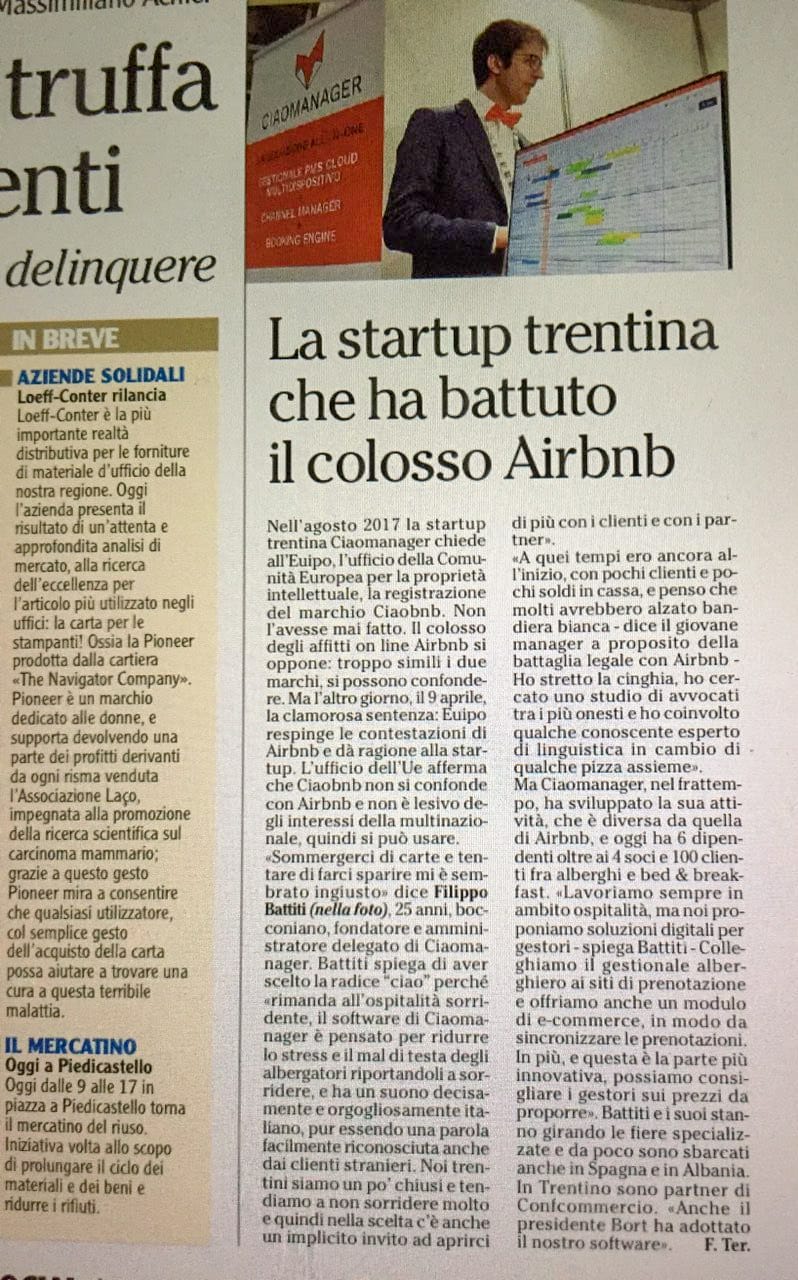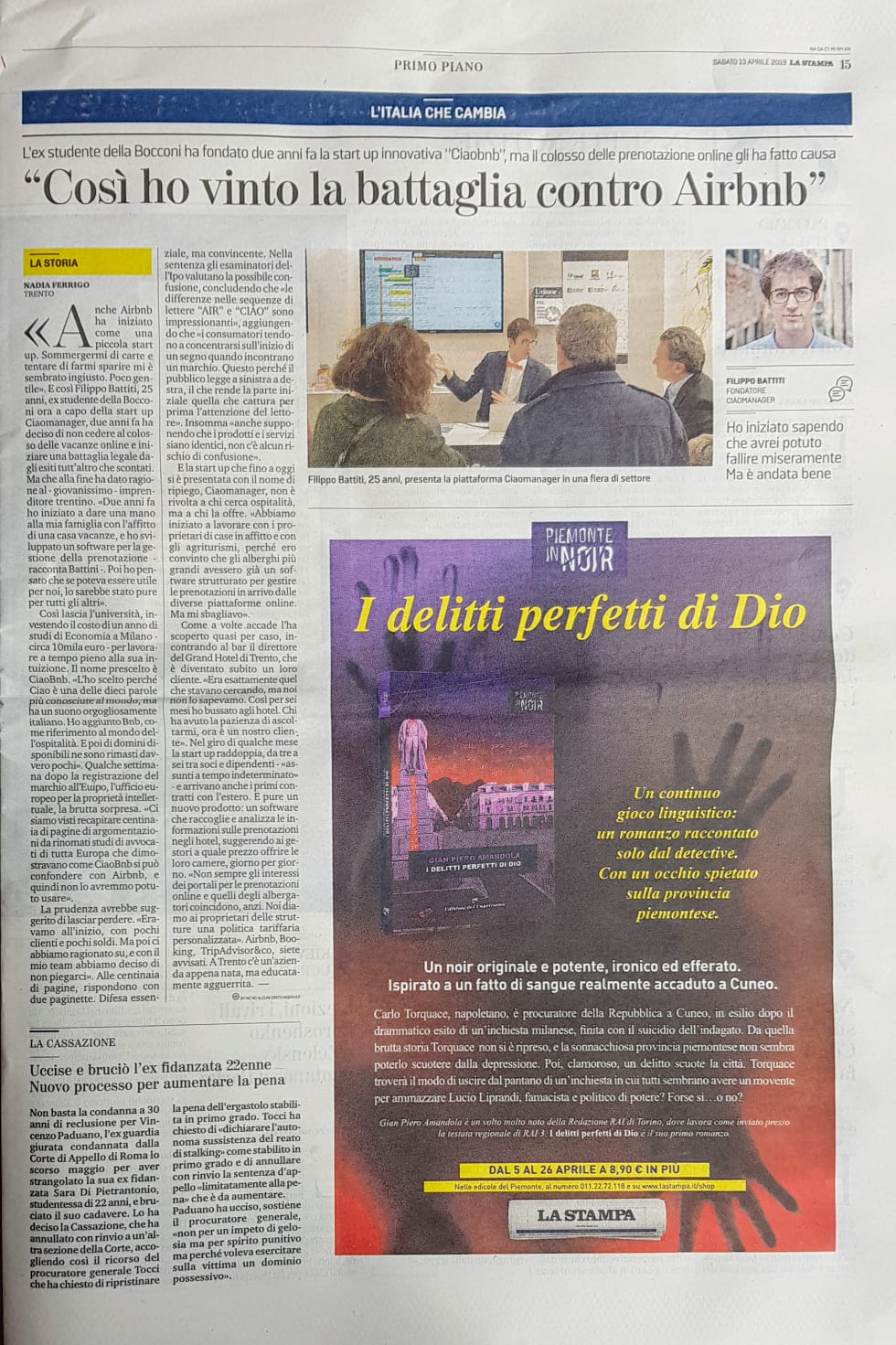




Advisory services provided to Ciaomanager S.r.l., which faced an opposition to the registration of the EU trade mark "Ciaobnb" by Airbnb Inc.

Avv. Fulvia Sangiacomo describes a recent case of defending Ciaomanager S.r.l. in the opposition to the registration of the EU trade mark "Ciaobnb", filed by Airbnb Inc.
By decision of 9 April 2019, EUIPO rejected in full opposition No. B002994021 filed by Airbnb Inc. against the registration of the EU trade mark "Ciaobnb" by Ciaomanager Srl, essentially holding that the ending "bnb" as such cannot be monopolised by the global online tourist rental platform.
Case summary
Scope of the advisory services:
By opposition filed on 17 November 2017, Airbnb sought the rejection of the application to register the mark "Ciaobnb" for applications and services in the tourism and hospitality sector, arguing that the use of the term "bnb" as the final part of the opposed mark constituted an improper, confusing attachment to the reputation of its platform and its mark "Airbnb".
Ciaomanager, assisted by the Biesse law firm of Brescia, defended itself by arguing primarily on the phonetic and conceptual differences between the two marks, sufficient to prevent any risk of confusion for the relevant public.
Advisory services provided:
As highlighted by Ciaomanager's defence, the terms "Air" and "Ciao", the distinctive elements of the two marks, differ phonetically and conceptually: the former evokes the concept of the "sharing economy", the latter a well-known Italian greeting.
The use of the term "bnb" as the final part of the contested mark would not create any improper attachment to the Airbnb trade mark, as that term is descriptive and evocative of the tourism and hospitality sector, and the reputation of the opponent's sign relates to the mark as a whole and not to its final part. Indeed, since the term "B&B", standing for "bed & breakfast", cannot be used as part of an internet domain name (due to the impossibility of using special characters such as "&"), the term "bnb" is frequently used in internet domains as a substitute for it. The choice to use this term is due to its similar pronunciation and also to the fact that the word "and" is commonly used in its abbreviated form "n", as in "Rock'n'roll" and "fish'n'chips".
Ciaomanager's defence therefore argued that the term "bnb" in itself lacked distinctive character, as it clearly evokes hotel and accommodation services.
Finally, Ciaobnb's defence highlighted that, as EUIPO has repeatedly noted, it is known that the public's attention is acoustically and visually focused on the first syllables of a mark, not the last: when reading text, a person's attention goes to the first letters of a word and not the last; otherwise it would be impossible to explain the very common copying errors that usually occur during hasty transcriptions (technically errors due to synthetic reading).
Airbnb contested the descriptive and evocative nature of the term "bnb" and its connection to the formula "B&B", reiterating the attachment to the reputation of its mark.
Outcome:
EUIPO first noted that the goods and services claimed in the contested registration application are indeed the same as those of the registration on which the opposition is based.
It noted that the earlier mark "Airbnb" is undoubtedly generally well known in the relevant market, where it enjoys a consolidated position among the leading marks, but that in EUIPO's view the relevant public in that market is an attentive public with above-average knowledge and attention.
EUIPO then found that, viewed as a whole, the two marks create a sufficiently distant overall impression, with a low degree of visual and phonetic similarity, determined mainly by their initial parts. The marks "Airbnb" and "Ciaobnb" share only the final element "bnb".
EUIPO did not rule on whether the term "bnb" had a greater or lesser distinctive character, having found the different overall impression of the marks both in relation to consumers for whom the term "bnb" has no meaning, and in relation – and all the more so – to those for whom the common element "bnb" has limited distinctive character, being evocative of the tourism and hospitality sector.
Considering the above, even though the goods and services are identical and the earlier mark has a high degree of distinctiveness as a whole, EUIPO found no likelihood of confusion on the part of the public.
Airbnb also argued the so-called risk of association, namely that the public might assume that the contested mark, "Ciaobnb", designates special Airbnb services in Italy, or a commercial collaboration. EUIPO, however, found that the very reference to the Italian nature of the word "Ciao" further increases the distance between the two marks.
EUIPO therefore, upholding Ciaobnb's defence, rejected Airbnb's opposition and declared the "Ciaobnb" mark registrable. Airbnb had until 9 June to appeal the decision.
Media coverage: