


Design Registration
Designs and Models Service
In the context of industrial property, the term "design" refers to the external appearance of a particular product, i.e. its aesthetics. The development of an original design can allow the capture of market share, the creation of new niches, the strengthening of a company's commercial image and its recognisability, in virtually every product sector. For these reasons, the protection of a product's design should always represent an essential element of every entrepreneur's or designer's commercial strategy.
Our intellectual property consultants have significant experience and are able to suggest the best form of protection for your products, in order to obtain the maximum possible protection, to combat or prevent counterfeiting, and at the same time to avoid potential legal actions by competitors.
Why Register a Design or Model?
Registration of a design (ornamental model) is the most effective tool (often the only one) validly enforceable against imitators in order to secure the exclusive right to the results of a creative and innovative effort of an aesthetic nature.
It is also well known that enforcing one's industrial property rights is a complex and articulated activity requiring specific expertise and mastery of a vast and evolving field. This certainly applies to ornamental designs and models as well.
It is therefore advisable to engage specialised consultants with experience in litigation, who are able to assist you in defining the best protection strategy. Biesse, with its team of professionals, assists its clients in defending their designs.
In Italy, current legislation provides several tools for the protection of design; in particular, the most important is the registration of a design or ornamental model, which may be obtained by filing an application with the Italian Patent and Trade Mark Office (UIBM). A design or model must be filed within 12 months of the date of first public disclosure, for example in the form of leaflets, brochures, the internet, trade fairs, etc. Registration may be requested by the creator of the design or model or, if they work for a company, by the company itself, provided that the creation of such work falls within the creator's duties; in general, the Applicant may be either a natural or a legal person.
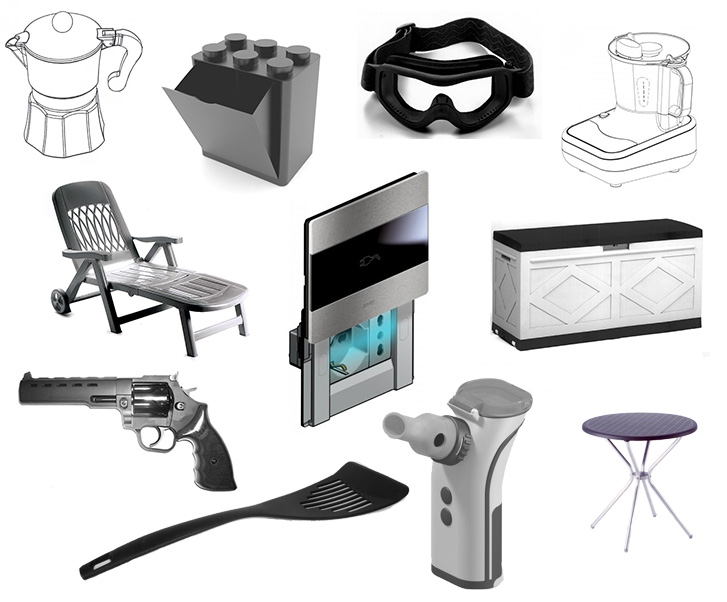
The duration of the title is 5 years from the date of filing of the application and may be extended, with renewals, for one or more five-year periods up to a maximum of 25 years. A single application may seek the registration of up to 100 designs or models, provided they are intended to be incorporated in or applied to objects belonging to the same class of the Locarno International Classification of designs and models. The following are some examples of Community designs registered by our firm:
Other forms of protection exist for the exterior features of a product: within the European Union, it is possible to obtain temporary protection for unregistered designs or models, for three years from the date on which the design or model was first disclosed within the territory of the Union.
This tool allows companies to carry out commercial tests and market assessments without incurring registration costs, bearing in mind that after 12 months it is in any case impossible to proceed with registration. The rights arising from an unregistered design or model are, however, difficult to enforce in legal proceedings, and the protection afforded to an unregistered design or model is considerably inferior to the certain and potentially long-lasting protection provided by a registered design or model.
A further tool provided by current legislation, which may be used cumulatively with design registration, is protection through copyright. This right, which lasts until 70 years after the author's death, is however obtainable only where the design or model has, in itself, a creative character and artistic value, and is enforceable only against voluntary infringements of the work.
If the design or model functions in the relevant market as a trade mark, i.e. has the primary effect of distinguishing it from competing products, it may also be protected as a three-dimensional trade mark or shape trade mark. This applies where the design or model, rather than having an essentially aesthetic or ornamental value, possesses an unusual, arbitrary, purely fanciful shape that gives it distinctive character.
This is the case, for example, of the truncated cone bottle of the Campari Soda aperitif and the iconic glass Coca-Cola bottle, which have been held to be registrable as trade marks.
Finally, the design or model is also protected by the rules on unfair competition, which protect the owner against acts such as slavish imitation, exploitation of reputation, and commercial attachment practices that are likely to cause confusion among consumers. In our Guide to Industrial Property Law you can find more information on the types of trade marks.
A company intending to export its products abroad, or intending to license out the production or marketing of those products, should always assess how to obtain design exclusivity in the countries of interest.
Where a design or model has been registered in Italy, it is possible to benefit from a 6-month period during which it is possible to "extend" the design or model by filing abroad while claiming the priority of the original Italian filing. After that period expires, the design or model can no longer be protected in countries that do not provide for a 12-month grace period from first disclosure, as in those countries the design would lack the novelty requirement.
There are essentially three ways to obtain protection for a design or model abroad:
- filing a series of separate national registration applications in different countries, each independent of the others (resulting in considerable complexity);
- registration of a European Union design: a single filing at the European Union Intellectual Property Office (EUIPO) can protect rights in all 28 EU member states; duration and requirements are substantially identical to those provided under Italian law;
- it is possible to file, at the World Intellectual Property Organization (WIPO), a single "international design or model", thereby obtaining in all contracting states (including Italy) the same protection that the model would obtain from individual direct national filings; it is possible to designate the European Union within an international registration, obtaining in the EU territory the same effects as a Community design.