


European patent
At present there is no Community patent. Some European Union countries have recently reached an agreement to this end and a new system, known as the unitary patent, came into force in June 2023, but only for 18 jurisdictions.
The European patent system arises from the ratification - by many European countries - of the European Patent Convention. The European patent application initially designates (covers) 39 states; these are the 27 EU countries plus the following: Albania, Iceland, Liechtenstein, Monaco, Norway, United Kingdom, Switzerland, Turkey, San Marino, North Macedonia, Montenegro and Serbia. At the time of filing, it is also possible to extend protection to further territories, including Bosnia and Herzegovina, Georgia, Laos, Cambodia, Montenegro, Morocco, Moldova and Tunisia.
The office responsible for the examination and grant of European patents is the European Patent Office (EPO).
In general, the procedure provides for a prior-art search, a validity examination, and, if the examination is successful, the grant of the European patent.
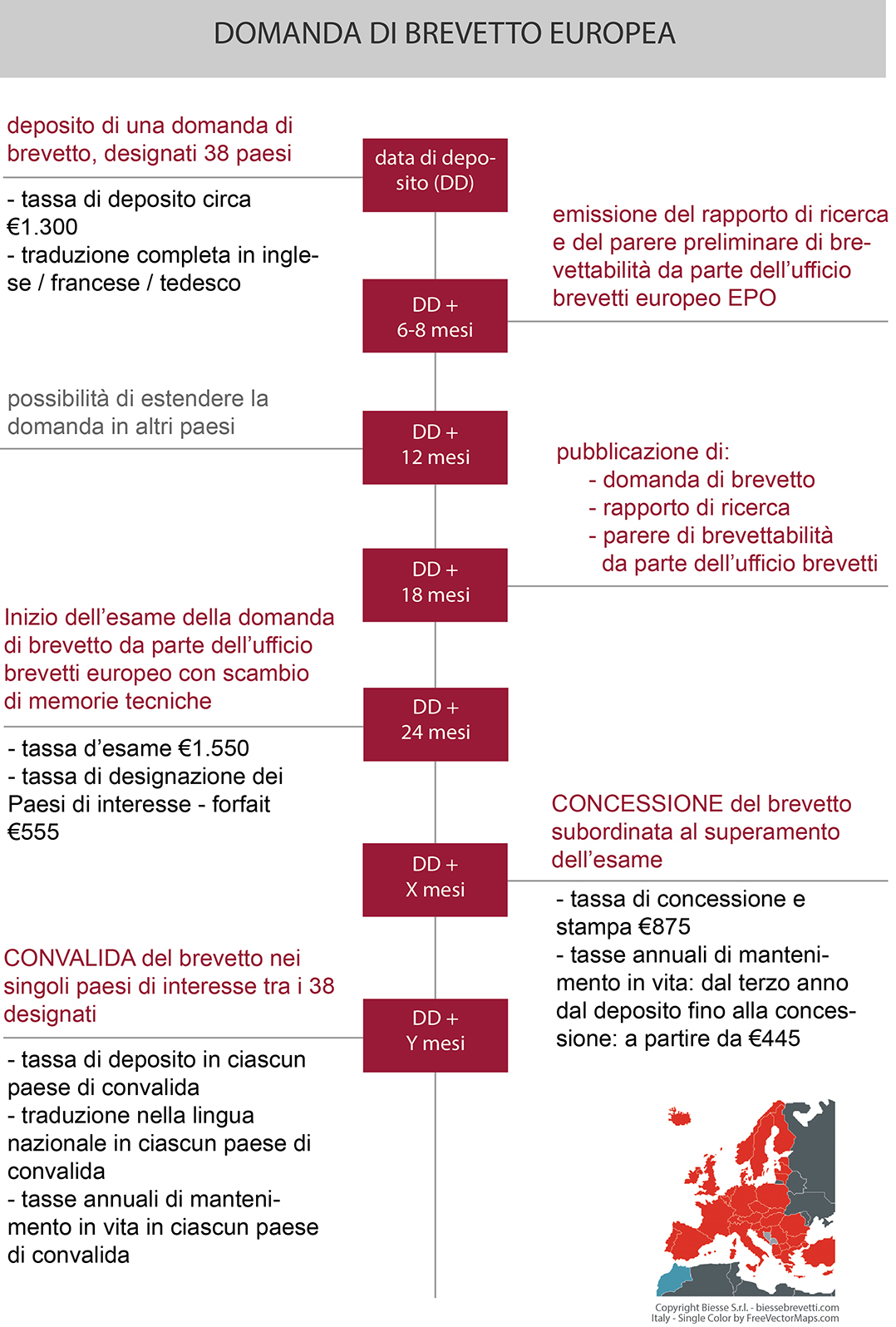
In more detail, at the time of filing, the filing and search fees are paid. The search report and the examiner's patentability opinion are issued about 6 to 8 months after filing. If it is decided to continue with the procedure, the designation fees and the examination fee must be paid within about 24 months of filing (or of the priority date).
During the examination, the examiner may issue one or more written communications (called Official Letters) in which objections concerning the patentability of the invention covered by the application are raised. It is compulsory to respond on the merits to all the objections raised.
At the end of the centralised procedure before the EPO, the application is either granted or refused.
With the entry into force of the Agreement on a Unified Patent Court (UPC) on 1 June 2023, the holder may pursue the European patent as a unitary patent and/or validate the European patent in some or all of the countries initially designated.
In the event of grant, the holder may choose two routes, which do not necessarily exclude one another:
• Traditional route: within 3 months of grant, validate the patent in the countries of interest among those initially designated. For some countries, validation requires the filing of the translation into the national language and the appointment of a local representative.
• Unitary patent: within 1 month of grant, request unitary effect from the EPO. The patent has unitary effect in all participating EU countries without further national procedures.
This dual possibility is dictated by two aspects.
The first aspect is that not all the countries that have signed the European Patent Convention have also signed the Agreement on a Unified Patent Court. In particular, as at 2026, the countries that have signed the latter are eighteen: Austria, Belgium, Bulgaria, Denmark, Estonia, Finland, France, Germany, Italy, Latvia, Lithuania, Luxembourg, Malta, Netherlands, Portugal, Romania, Slovenia and Sweden. Therefore, for the countries not party to the UPC Agreement, the only choice is to validate the European patent in the traditional way.
The second aspect is linked to the fact that the Agreement on a Unified Patent Court (UPC) introduced a transitional regime, with an initial duration of seven years from 1 June 2023 (potentially extendable by a further seven years), which allows European patent holders not to choose the unitary patent for the countries party to the UPC Agreement, but the route of traditional validations, removing from the jurisdiction of the UPC the invalidity and infringement actions relating to the corresponding European patents. Therefore, for example, in Italy and Germany (both party to the UPC Agreement) a European patent can still be validated today, without necessarily having to request the unitary patent.
Therefore, after grant the holder has two options:
• Mixed option: The first option consists of pursuing the European patent as a unitary patent, which has uniform effect in all the countries that have joined the UPC Agreement, and possibly also validating it in the countries not party to the Agreement (for example Spain, Switzerland);
• Classic option: The second option is not to opt for the unitary patent and to choose the option of validating the patent in one or more of the 39 countries initially designated
Third parties may file an opposition to the grant of the patent within nine months of the grant date before the EPO.
The European procedure has the enormous advantage of being able to reach up to 39 countries with a single filing and a single examination procedure, deferring to the time of grant the actual choice of the countries of interest and the related costs.
European procedure and the filing fees for the European patent
In practice, the European procedure develops according to the following scheme: