


European Union trademark
Registering a European Union trademark (EUTM, European or Community trademark)
In March 2016, the regulation on the European Union trademark came into force, amending the regulation on the Community trademark. The name of the Office for Harmonization in the Internal Market (OHIM) also changed, officially replaced by EUIPO, the European Union Intellectual Property Office. At the same time, the Community trademark became the European Union trademark (EUTM).
With a single registration application, it is possible to obtain legal protection for your trademark in all the member countries of the European Union. The European Union trademark (EUTM) therefore has supranational scope and confers on the holder an exclusive right in the 27 states, and automatically extends to every new EU member. Unlike the international registration (which is a bundle of national trademarks), the EUTM is a single trademark valid for all EU countries and it is therefore impossible to limit the geographical scope of protection to only some member states. The registration application must be submitted to the European Union Intellectual Property Office (EUIPO) in Alicante (Spain).
No one is obliged to be assisted by an attorney for the filing of an EU trademark. Often, however, those who proceed on their own underestimate the importance of defining a correct filing strategy, aimed at reducing the risks of challenge, making the trademark as protectable as possible and facilitating its extension abroad, with optimised costs.
Finally, even the choice of the goods and/or services to be protected is not as straightforward as it seems, and varies according to the type of business and the holder's prospects, given that "defensive" filings also exist. In the event of a subsequent extension abroad, a classification that is not entirely correct can lead to refusals or additional costs.
For all these reasons, it is always advisable to rely on a consultancy firm such as BIESSE to define from the outset the best strategy for registering your trademark, because it is better to spend something at the start and set off on the right foot rather than later having to bear the costs of litigation and/or oppositions and/or invalidity of your trademark.
The EUTM may be registered by natural persons holding the nationality of, or domiciled in, an EU member state; and by legal persons having their registered office or an established place of business in an EU member state.
EUTM countries
Austria, Belgium, Bulgaria, Cyprus, Croatia, Denmark, Estonia, Finland, France, Germany, Greece, Ireland, Italy, Latvia, Lithuania, Luxembourg, Malta, Netherlands, Poland, Portugal, United Kingdom, Czech Republic, Romania, Slovakia, Slovenia, Spain, Sweden, Hungary
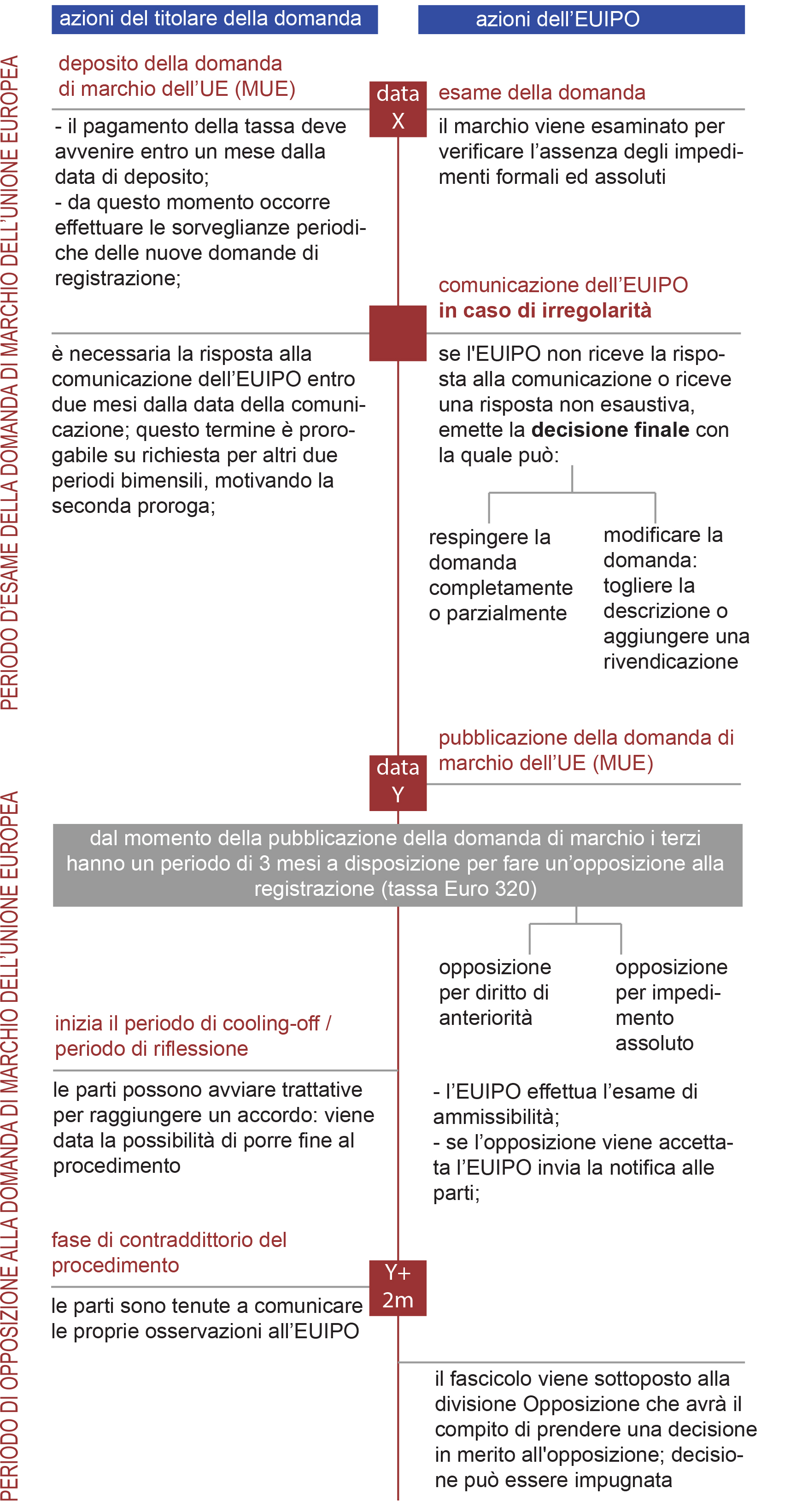
Procedure for registering an EU trademark (EUTM)
The application for the registration of an EUTM must be submitted in two languages, one of which must be chosen among the official languages of the European Union (Italian, French, English, German and Spanish). Therefore, if the registration application is submitted in Italian, the second language of the application can be chosen from the remaining four official languages (French, English, German and Spanish).
The standard procedure for registering a trademark is normally divided into four phases:
EU trademark registrations are granted without a prior examination of earlier rights; they are therefore always subject to the risk of possible oppositions and/or invalidity actions by third parties, since the existence of identical or similar earlier trademarks, designs, copyrights, domain names, business and/or company names, used or filed for identical or similar goods, may invalidate the registration and/or use of a subsequent trademark.
Registration of a trademark may also be refused if the trademark is deemed to lack distinctive character, that is, if it consists exclusively of wordings or logos that have become common in current language or in the constant practices of trade, or if it is made up exclusively of generic denominations of goods or services or of descriptive indications referring to them (type, intended purpose, quality, etc.). Refusals may also be based on unlawfulness and/or interference with other bodies of rules, such as those governing DOC, PGI, etc.
Should a European Union trademark application be refused or cancelled, it is possible to request its conversion into individual national applications in the countries where there are no impediments to its registration. In this case, for the purposes of the trademark's novelty, the date of the European filing or of any priority claimed prevails.
The European Union trademark is valid for ten years and can be renewed indefinitely for further ten-year periods. Finally, since the EUIPO does not carry out an examination of earlier rights, it is advisable to activate a watch service on your trademark, in order to intervene promptly in the event of subsequent filings of confusingly similar trademarks.
Procedure for registering an EUTM
How much it costs to file an EU trademark
To file an application for the registration of an EUTM, the filing fee must be paid to the EUIPO, which depends on the number of classes.
- the preliminary analysis of the trademark's registrability
- the search and assessment of prior rights
- the selection of the classes of services and/or goods for which the trademark is to be registered
- the definition of the territorial scope of protection
- the filing activities and uploading into the deadline management system
- the response to any objections from the office at the time of registration
- assistance in the event of oppositions or invalidity actions
- the drafting of coexistence agreements
On top of the filing fees, the fees of a lawyer or trademark attorney for advisory services must be added, which may include: