



Italian patent
Italian Patent
A patent application in Italy makes it possible to protect an invention throughout the national territory, and also in the territory of the Republic of San Marino.
From 2008 onwards, the procedure underwent profound changes, aimed at harmonising Italian patent practice with that of the northern European countries, in which the grant of the patent is subject to passing a substantive examination by the patent office.
In particular, the prior-art search and the substantive examination of patent applications were introduced. Broadly speaking, the patenting procedure in Italy develops according to the following phases:
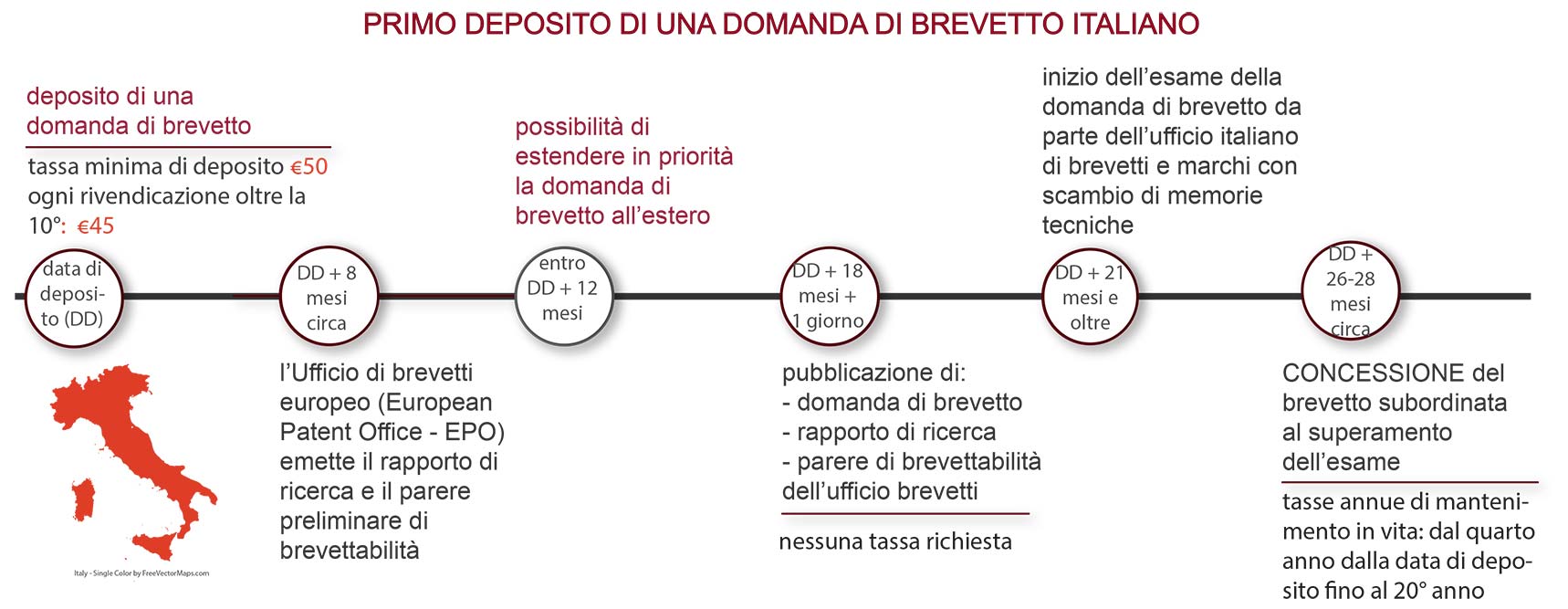
- Filing: from the fourth year after the filing date, the patent is subject to the payment of annual maintenance fees;
- Search report: about 6 to 8 months after the application is filed, the patent office issues a search report, containing the list of documents deemed relevant for the subsequent examination of the application, and the examiner's non-binding preliminary patentability opinion;
- Extension abroad: within 12 months of filing it is possible to extend the application to one or more foreign countries, claiming the priority of the Italian filing;
- Substantive examination: 21 months after filing, the substantive examination by the Italian Patent and Trademark Office (UIBM) begins, the duration of which varies depending on the case. The examination consists of at least one exchange of letters with the examiner;
- Grant and publication: if the examination is passed, the application is granted and the grant certificate published.
Patentability Requirements
Novelty and inventive step are the two main requirements for obtaining a patent (articles 46 and 48 of the Industrial Property Code, CPI). The invention must be new with respect to the state of the art, and the differences that make it new must be substantial, not trivial.
The other requirements are industrial applicability (art. 49 CPI), lawfulness (art. 50 CPI) and sufficiency of disclosure (art. 51 CPI).
The national patent application or patent can be enforced in Italy and San Marino at any point in the procedure against an alleged infringer, and may be attached to the request for intervention by the customs authority.
Advantages of the Italian Procedure
The advantages offered by the Italian procedure are several. Among the main ones are the very low filing costs and obtaining the search report and the examiner's opinion free of charge. The costs of the search report are in fact borne by the Italian state, that is, by the taxpayers, and not directly by the holder of the patent application. The search report and the preliminary patentability opinion are prepared by the European Patent Office (EPO) on behalf of the Italian office (UIBM).
In practice, the Italian procedure develops according to the following scheme:
Utility model
In addition to the patent application for an industrial invention, in Italy it is possible to file a patent application for a utility model. New models suitable for giving particular efficacy or ease of application or use to machines, or parts of them, instruments, tools or objects of general use may form the subject of a utility model patent, such as new models consisting of particular shapes, arrangements, configurations or combinations of parts. The patent for machines as a whole does not include the protection of the individual parts.
The utility model cannot claim a production process or a manufacturing method. In other words, manufacturing methods and processes cannot by law be protected with utility models (but at most with a patent for an industrial invention).
The utility model must therefore satisfy the requirement of novelty, exactly as provided for industrial invention patents. The assessment of inventive step, however, differs between the two cases. For utility models it is sufficient that the claimed technical solution gives particular efficacy or ease of application or use. In other words, for the utility model a lower level of inventive step is sufficient than that provided for industrial invention patents.
Utility models in Italy are granted without a substantive examination by the patent office (UIBM). That is, the UIBM merely carries out a formal examination of the application, but does not perform any verification of the novelty and inventive step of what is claimed in the application itself.
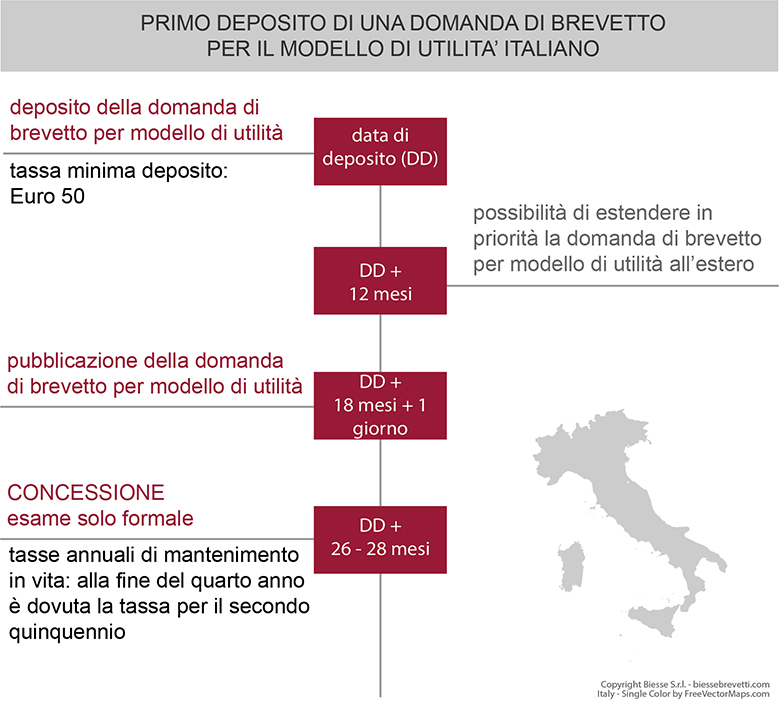
The maximum duration of utility models is 10 years from the filing date. At the time of filing, the maintenance fees for the first five-year period are paid. At the end of the fourth year from filing, the maintenance fee for the second five-year period is due.
In practice, the Italian utility model procedure develops according to the following scheme: